Finders Keepers | Finders Law
Finders Keepers | Finders Law
Ever since the phrase came into being in the early nineteenth century, documented as no halfers-findee, lossee seekee, which sou..link

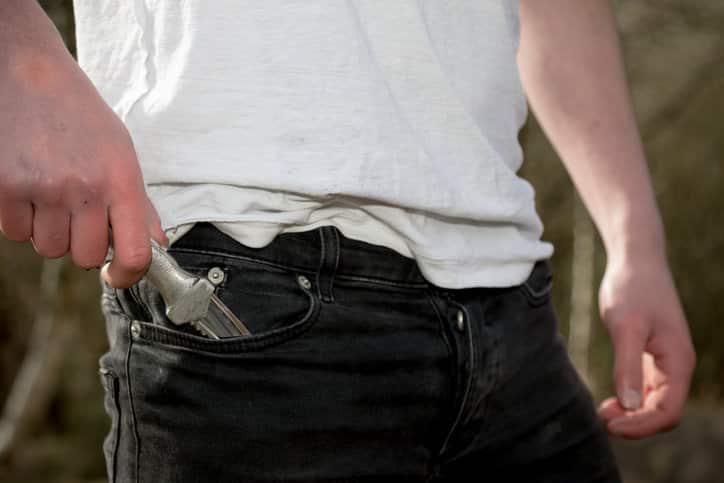
Carrying a knife or offensive weapon in public is a serious criminal offence. A person does not have to use the weapon or threaten anyone before an offence may be committed.
The law regulates possession, threatening behaviour, sales to children, remote sales and the possession of certain prohibited weapons.
It is generally an offence to possess an article with a blade or sharp point in a public place without lawful authority or a good reason.
There is a limited exception for a folding pocketknife where the cutting edge does not exceed three inches. However, carrying even a small folding knife may still be unlawful where it is intended for use as a weapon.
A public place can include:
An offensive weapon may be:
An ordinary object may therefore become an offensive weapon because of the way it has been altered or the purpose for which it is being carried.
A person may have a defence where there was lawful authority or a good reason for possessing the knife or bladed article.
Possible examples include:
Whether an explanation amounts to a good reason depends on the circumstances and the available evidence.
Carrying a knife for self-defence is unlikely to provide a lawful excuse because it may demonstrate an intention to use the item as a weapon.
Using a knife or offensive weapon to threaten another person can result in a more serious charge.
Depending on the offence, the prosecution may need to prove that there was an immediate risk of serious physical harm or that a reasonable person would have believed such a risk existed.
A knife possession offence can result in imprisonment, a fine or both.
The court may consider:
Minimum custodial sentencing provisions can apply to repeat adult offenders and to some repeat youth offenders. The court may depart from the minimum sentence where particular circumstances would make it unjust.
It is an offence to sell most knives and certain bladed articles to a person under 18.
Businesses must have effective procedures for checking the age of the buyer and, where applicable, the person receiving the delivery.
The Crime and Policing Act 2026 strengthened controls applying to online and remote knife sales.
The legislation includes enhanced age-verification requirements and additional responsibilities concerning the sale and delivery of knives and bladed articles.
Businesses must check which provisions have commenced and comply with the legislation and statutory guidance in force at the time of the transaction.
The 2026 Act includes requirements concerning specified bulk or suspicious transactions involving bladed articles.
Sellers and online services may be required to identify and report transactions that meet the statutory criteria.
The legislation includes measures intended to increase accountability where an online platform fails to address unlawful knife sales or illegal knife-related content.
Depending on the provision and its commencement, responsibility may extend to designated senior managers of the relevant service.
The 2026 Act also extends police powers concerning dangerous knives found on private property.
Where officers are lawfully present and reasonably suspect that a weapon is likely to be used in connection with unlawful violence, they may be able to seize and retain it and seek its forfeiture or destruction.
Some knives and weapons are prohibited regardless of whether they are carried in public. Restrictions may apply to possessing, selling, hiring, importing or transferring them.
The prohibited-weapons list has changed over time. Anyone unsure whether a particular knife or weapon is lawful should obtain specialist advice rather than relying on its description or appearance.
A person arrested or voluntarily interviewed about a knife offence is entitled to free and independent legal advice at the police station.
What is said during an interview may significantly affect any later prosecution. A person should obtain advice before answering questions or providing a prepared statement.
Solicitors.com is not a firm of solicitors. This article is provided for general information only and does not constitute legal advice. You should seek advice from a suitably qualified solicitor about your individual circumstances.



This is a highly specialised area of the Law and covers both aircraft and their facilities as well as many other areas detailed here.
link
As a charity it is important to understand your legal obligations and rights, a Charity Law solicitor swill be able to help with this, find Charity Law Solicitors from Solicitors.com
link
Solicitors.com - if you are looking to take action under the Human Rights Act, understand your rights and how a solicitor can assist you.
link

We have produced a few guides to help you but would recommend that you speak to a solicitor as all situations are different.
link



If you are looking to buy a property abroad you will need expert legal advice, this section details services provided, and offers guidance on how to find a solicitor for your needs.
linkWhat is Double Jeopardy? and is it still Law in the UK?..
linkFinders Keepers | Finders Law
Ever since the phrase came into being in the early nineteenth century, documented as no halfers-findee, lossee seekee, which sou..link
Social workers could face up to five years in jail should they prove guilty of wilful neglect towards children, if consultation decides to extend the law to inc..link
Police Reforms - With the government recently announcing that they will be reviewing the stop and search rules we take a look at the rules that apply...link
Over 2000 section 60 notices have been issued in London last year..
linkFlexible Working Hours. -
The right to request flexible working hours has been extended to all employees...link
Family law, Changes to help victims of controlling behaviour.
The Home Secretary had announced new laws to help victims of psychological and emotional abuse b..link
Finding a valuable item.
Every now and then someone finds a stash of coins or jewellery that is 100's of years old, may have been lost, buried as part of a ce..link
Police Chiefs are calling for a change in the 'stop and search' l..
linkNew Food Laws to reduce allergic reactions.
The new measures have come into force across Europe, Staff in Restaurants and Takeaways are now required to give in..link
Law targeting charity fundraising - Vulnerable people are to be protected from fundraising activities by charities, the chancellor has announced in the budget...link
Up until a child reaches the age of 12, or 135 cm, a child must use a booster or car seat, when a child is not required to use a car seat or booster they must,..link
Solicitors.com are not a firm of solicitors, and any content on the site should not be used in substitute for obtaining Legal advice from a solicitor regulated in the UK, Solicitors.com recommends that you contact a firm of solicitors to discuss your individual legal requirement. Whilst we strive to bring you accurate up to date content, all content on this site is not legal advice and is not guaranteed to be correct. Use of this site does not create a client relationship.

Step by step guide to help you understand the process of Conveyancing and moving.
link.jpg)
We have put together a few guidance notes for your help with Criminal law matters, if you require a solicitors please use the search facility or ask a question.
link
If you are looking for a commercial solicitor understand your options by contacting one of the 100s of commercial law firms on solicitors.com
link
If you are considering making a claim for Medical Negligence understand your rights and the process, find a medical compensation solicitor via solicitors.com
link
The amount of money owing may dictate the route you take to reclaim your money, we recommend that you discuss your situation with a solicitor, or you can call the CAB on 0808 223 1133.
link
To undertake a dental negligence claim you must have sustained an injury or damage, as a result of the dental treatment understand the options available to you.
link

Family Law Solicitors can help you resolve the problems which may arise in the break-up of relationships, including financial issues and matters concerning any children.
link
Will be able to assist on all areas of Motoring Law for Example Drink Driving, Dangerous Driving, Careless Driving, Totting Up, Speeding, Driving Without Insurance motor offences.
link
Find a solicitor that can assist with wills, probate and estate planning in your area.
link